Valet 2026 · Regionvalet · Norrtälje
Fler röster än röstberättigade i fyra valdistrikt i Norrtälje
Valmyndighetens slutliga räkning i regionvalet anger 167–172 procents valdeltagande i fyra valdistrikt i Norrtälje. Sverigedemokraterna gynnas mest och Vänsterpartiet drabbas mest. Mandaten mellan partierna ändras inte. Talen rättades 5 oktober.
Källa: Valmyndigheten (val.se), slutlig räkning i regionvalet 2026 i Region Stockholm.
Publicerad kl. 20.42. Senast uppdaterad kl. 18.56.
Uppdatering 5 oktober 2026: resultatet har rättats. Valmyndigheten har publicerat nya tal för de fyra valdistrikten, och Länsstyrelsen i Stockholm har rättat protokollet över valet. Resten av texten beskriver talen som de stod hos Valmyndigheten 4 oktober. Till uppdateringen
Röster och röstberättigade i de fyra valdistrikten
| Regionvalet, slutlig räkning, val.se 4 oktober | Kommunvalet, slutlig räkning | ||||
|---|---|---|---|---|---|
| Valdistrikt | Röstberättigade | Röster totalt | Valdeltagande enligt val.se | Röster totalt | Valdeltagande enligt val.se |
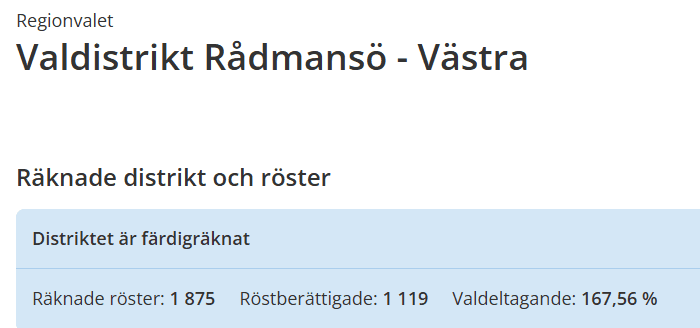
| Rådmansö - Västra | 1 119 | 1 875 | 167,56 % | 954 | 85,25 % |
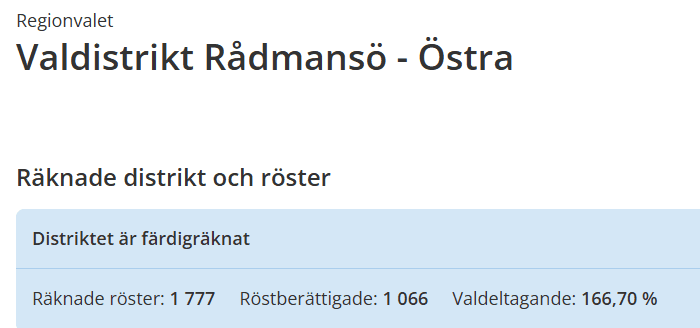
| Rådmansö - Östra | 1 066 | 1 777 | 166,70 % | 903 | 84,71 % |
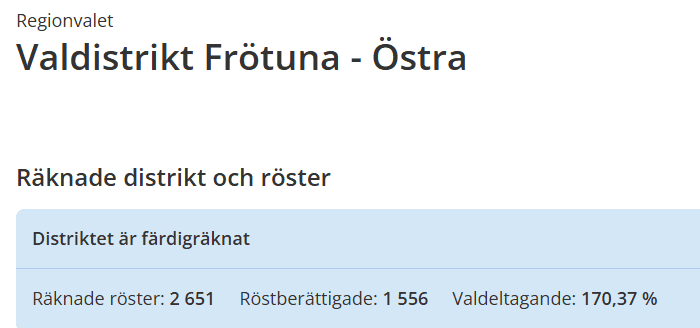
| Frötuna - Östra | 1 556 | 2 651 | 170,37 % | 1 336 | 85,86 % |
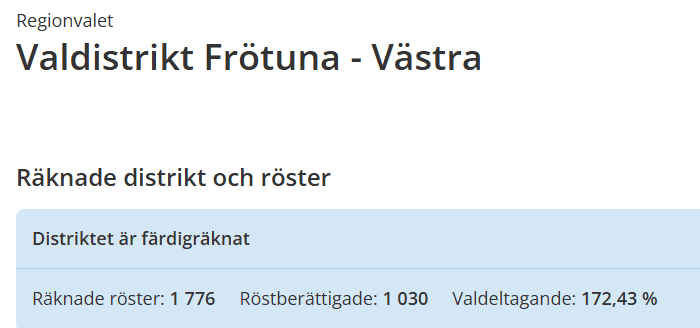
| Frötuna - Västra | 1 030 | 1 776 | 172,43 % | 895 | 86,89 % |
Ett valdistrikt är det område vars väljare röstar i samma vallokal. Antalet röstberättigade är detsamma i båda valen. Slutlig räkning är länsstyrelsens räkning av alla röster efter valnatten, och Länsstyrelsen i Stockholm fastställde regionvalet i protokoll 2 oktober 2026 (dnr 51168-2026).
Kommentar. Ett valdeltagande på 172 procent borde inte vara svårt att upptäcka som ett uppenbart fel. Ändå har fyra fall av valdeltagande över hundra procent passerat länsstyrelsens slutliga räkning, beslutet att fastställa valet och publiceringen hos Valmyndigheten utan att någon reagerat. Ingen nyhetsredaktion har uppmärksammat det, under en tid då rapporteringen om valet har handlat om ”röstfusk” och ”klanröstning”, trots att kontroller av det här slaget är relativt enkla att göra.
Jag har kontrollerat siffrorna i omgångar, räknat om dem flera gånger och jämfört med val.se. Siffrorna ligger i skrivande stund fortfarande öppet hos Valmyndigheten, och vem som helst kan kontrollera dem via länkarna i texten.
Det bör understrykas att det här är ett undantag. Valkoll har gått igenom alla valdistrikt i landet i de tre valen och hittat mönstret i fyra av dem. Mandaten ändras inte, och samma personer ser ut att bli valda (även om sverigedemokraten Britt Mari Canhasi i det här fallet blir invald på personröster i stället för efter listordningen). Det är ändå allvarligt. Ett fastställt valresultat ska inte innehålla fler röster än röstberättigade, och en kontroll som missar det kan missa annat.
Jag har ställt frågor till Länsstyrelsen i Stockholm och Valmyndigheten och kommer med en uppföljning när jag har fått svar. Uppdatering 5 oktober: Länsstyrelsen i Stockholm svarar att valkansliet undersöker saken tillsammans med Valmyndigheten, och att något ”verkar uppenbarligen inte stämma”. Senare samma dag: länsstyrelsen skriver att felet har identifierats och är på väg att åtgärdas tillsammans med Valmyndigheten.
Uppdatering 5 oktober kväll: Felet är nu rättat. Jag hörde av mig till Länsstyrelsen i Stockholm och Valmyndigheten den 4 oktober. Dagen efter svarade länsstyrelsen att felet jag frågade om hade identifierats, och samma eftermiddag publicerade Valmyndigheten nya tal och länsstyrelsen ett rättelsebeslut. Rösterna i de fyra valdistrikten hade registrerats dubbelt, enligt Valmyndigheten på grund av ett tillfälligt it-fel.
Rättelsen ändrar också grunden för ett mandat. Sverigedemokraten Britt Mari Canhasi valdes enligt det första protokollet in på personröster, med 5,04 procent. Med de rättade talen har hon 4,98 procent och når inte över spärren på 5 procent. Hon väljs i stället in efter ordningen på valsedeln, där hon står först. Det var den följden jag räknade fram här den 4 oktober. Valet var då redan fastställt med de felaktiga talen.
 Victor Pressfeldt
Uppdatering 5 oktober: resultatet har rättats
Resten av texten beskriver talen som de stod hos Valmyndigheten när Valkoll publicerade granskningen 4 oktober. Sedan dess har följande hänt.
Talen är rättade. Den 5 oktober publicerade Valmyndigheten nya tal för de fyra valdistrikten. Rättelsen kom dagen efter att Valkoll den 4 oktober frågade Länsstyrelsen i Stockholm och Valmyndigheten om talen. Varje partis röstetal i de fyra valdistrikten är nu exakt hälften av det som publicerades 2 oktober, och valdeltagandet är 84–87 procent i stället för 167–172 procent. Regionen har 4 002 färre giltiga röster, 1 562 121 i stället för 1 566 123.
| Publicerat 2 oktober | Rättat 5 oktober | ||||
|---|---|---|---|---|---|
| Valdistrikt | Röstberättigade | Röster totalt | Valdeltagande enligt val.se | Röster totalt | Valdeltagande enligt val.se |
| Rådmansö - Västra | 1 119 | 1 875 | 167,56 % | 949 | 84,81 % |
| Rådmansö - Östra | 1 066 | 1 777 | 166,70 % | 900 | 84,43 % |
| Frötuna - Östra | 1 556 | 2 651 | 170,37 % | 1 332 | 85,60 % |
| Frötuna - Västra | 1 030 | 1 776 | 172,43 % | 896 | 86,99 % |
Källa: Valmyndigheten (val.se), slutlig räkning i regionvalet, hämtat 4 oktober och 5 oktober 2026 kl. 16.57.
Vad som hände, enligt Valmyndigheten. Valkoll ställde sex följdfrågor till Valmyndigheten 5 oktober kl. 13.41. Svaret kom kl. 16.06: ”Efter att länsstyrelsen godkänt de fyra valdistrikten skickades det iväg dubbla registreringar för dessa valdistrikt. Det berodde på ett temporärt fel i it-systemet.” Länsstyrelsen har enligt svaret godkänt de fyra valdistrikten på nytt, och ”resultatet har skickats vidare utan fel”. På frågan om övriga valdistrikt har kontrollerats svarar Valmyndigheten: ”Ja, endast dessa fyra valdistrikt är berörda.”
Det fastställda resultatet är ändrat. Länsstyrelsen i Stockholm har lagt ett rättelsebeslut (dnr 51467-2026) i protokollet över valet, med stöd av 36 § förvaltningslagen. Där står att bilagorna till protokollet har ”innehållit en uppenbar felaktighet till följd av ett förbiseende” och att röstetalen för samtliga partier har halverats i de fyra valdistrikten.
Personvalet ändras. Rättelsebeslutet har samma tal som Valkoll räknade fram 4 oktober: ”Britt-Mari Canhasi, Sverigedemokraterna, tilldelas 1 128 personröster i stället för 1 182 i valkrets Nordost.” Andelen blir ”4,98 procent i stället för 5,04 procent, och hon når därmed inte över personröstspärren utan väljs in på jämförelsetal utifrån namnordningen på valsedlarna”. Hon är alltså fortfarande vald, men efter ordningen på valsedeln och inte på personröster. Valmyndigheten svarar: ”Ledamotsordningen mellan kandidaterna påverkas inte. Kandidaternas ersättare förblir också desamma.”
Mandaten ändras inte. Partiernas mandat i Valmyndighetens rättade tal är desamma som före rättelsen.
Vad Valkoll fortfarande inte vet. Hur talen kunde passera länsstyrelsens beslut att fastställa valet 2 oktober och publiceringen hos Valmyndigheten utan att upptäckas. Uppgiften om ett tillfälligt it-fel är Valmyndighetens. Valkoll har inte kunnat kontrollera den.
Det rättade protokollet (pdf, 637 sidor) har samma datum och adress som det första. Det första protokollet (pdf, 636 sidor) finns kvar som kopia hos Valkoll.
Så ser det ut på val.se
Skärmbilder av de fyra valdistriktens sidor på resultat.val.se, Valmyndighetens resultatsajt, tagna 4 oktober 2026.
En sverigedemokrat klarar personröstspärren med nio röster
Uppdatering 5 oktober: Det här avsnittet beskriver talen som de stod hos Valmyndigheten 4 oktober, före rättelsen. Se uppdateringen 5 oktober.
En kandidat kan väljas in på personröster om personrösterna är minst 5 procent av partiets röster i valkretsen, dock minst 100. I Länsstyrelsen i Stockholms protokoll över valet (pdf, 636 sidor), bilaga 5 (sidan 613), står det: Spärren för inval på personligt röstetal är 5 % av partiets röster, dock minst 100 personröster i valkretsen.
Enligt länsstyrelsens protokoll (bilaga 5, sidan 616) har Britt Mari Canhasi (SD) i valkretsen Nordost 1 182 personröster, 5,04 procent av partiets 23 456 röster där, och tar partiets första mandat på personligt röstetal (bilaga 10, sidan 633). Det är nio röster över spärren, som med partiets röstetal är minst 1 173 personröster.
Partiernas röster i de fyra valdistrikten ser ut att ha räknats dubbelt (se nästa avsnitt). 108 av personrösterna kommer från de fyra valdistrikten. Om de fyra valdistriktens tal vore hälften så stora skulle kandidaten ha 1 128 personröster av partiets 22 632 röster, 4,98 procent. Det är fyra röster under spärren, som då är minst 1 132 personröster.
Kandidaten står på plats 1 på Sverigedemokraternas valsedel i Nordost (listnummer 0110-10393) i val.se:s filer och ser därför ut att få mandatet ändå. När personrösterna inte räcker går platsen enligt vallagen (14 kap. 10 §) till den kandidat som står först på flest valsedlar. Skillnaden mellan de publicerade och de halverade talen gäller på vilken grund mandatet tilldelas, inte om kandidaten blir vald.
Vad siffrorna visar
Partiernas röster i de fyra valdistrikten ser ut att ha räknats dubbelt i regionvalets slutliga räkning.
- Varje partis röstetal i de fyra valdistrikten är ett jämnt tal, och antalet giltiga röster är ungefär dubbelt så stort som i kommunvalet i samma valdistrikt, 1,98–2,00 gånger.
- I val.se:s filer för de fyra valdistrikten är varje partis summerade personröster, alltså kryss för en viss kandidat, exakt dubbelt så många som personrösterna på partiets valsedlar i samma fil. I kommunvalets filer för samma valdistrikt är de två talen lika.
- De ogiltiga rösterna är inte fördubblade. De fyra valdistrikten har tillsammans 75 ogiltiga röster i regionvalet och 62 i kommunvalet.
- Inget annat valdistrikt har samma mönster i den slutliga räkningen av regionvalet, kommunvalet eller riksdagsvalet, och inget annat valdistrikt når 95 procents valdeltagande i regionvalet. Högst i övrigt är 94,74 procent. Valkoll har gått igenom alla valdistrikt i landet i de tre valen.
- Talen ingår i summorna i Länsstyrelsen i Stockholms protokoll: 1 566 123 giltiga röster i hela regionen och 185 642 i valkretsen Nordost, där Norrtälje ingår.
Vad det betyder för valresultatet
Valkoll har räknat om mandatfördelningen i Region Stockholm med vallagens metod. Om partiernas röster i de fyra valdistrikten vore hälften så stora, alltså 4 002 röster färre, blir fördelningen av de 149 mandaten mellan partier och valkretsar densamma.
KD har det sista mandatet. Det går till S först om KD tappar minst 1 496 röster i regionen. KD har 682 röster i de fyra valdistrikten.
Partiernas röster i de fyra valdistrikten
Skillnaderna är små. Sverigedemokraterna har mest att vinna på de publicerade talen och Vänsterpartiet mest att förlora: om de fyra valdistriktens tal vore hälften så stora skulle Sverigedemokraternas andel av rösterna i regionen vara 0,03 procentenheter lägre och Vänsterpartiets 0,02 procentenheter högre. Inget parti vinner eller förlorar mandat.
| Röster i de fyra valdistrikten | Andel av rösterna i regionen | |||
|---|---|---|---|---|
| Parti | Enligt val.se | Hälften så många | Med val.se:s tal | Om talen halveras |
| M | 2 178 | 1 089 | 23,86 % | 23,85 % |
| S | 1 946 | 973 | 28,10 % | 28,11 % |
| SD | 1 648 | 824 | 10,03 % | 10,00 % |
| KD | 682 | 341 | 7,04 % | 7,03 % |
| C | 536 | 268 | 6,91 % | 6,91 % |
| MP | 374 | 187 | 7,27 % | 7,28 % |
| L | 328 | 164 | 4,07 % | 4,07 % |
| V | 278 | 139 | 11,83 % | 11,85 % |
| Övriga partier | 34 | 17 | ||
| Summa giltiga röster | 8 004 | 4 002 | ||
Vad Valkoll inte vet
Uppdatering 5 oktober: Det här avsnittet beskriver talen som de stod hos Valmyndigheten 4 oktober, före rättelsen. Se uppdateringen 5 oktober.
Valkoll vet inte hur det gick till eller vilka tal som är de rätta. Valkoll frågade Länsstyrelsen i Stockholm och Valmyndigheten den 4 oktober 2026 kl. 15.27 om de publicerade talen stämmer med länsstyrelsens räkning. Länsstyrelsen svarade den 5 oktober kl. 11.49: ”Länsstyrelsens valkansli håller på att undersöka det som du frågar om, tillsammans med Valmyndigheten. Något verkar uppenbarligen inte stämma – men vad som hänt här vet vi ännu inte.” Senare samma dag skrev länsstyrelsen: ”Enligt uppgifter som jag just fick från Länsstyrelsens valsamordnare har felet du frågar om identifierats och är på väg att åtgärdas tillsammans med Valmyndigheten.” Länsstyrelsen hänvisar ytterligare frågor till Valmyndigheten. Vilka tal som är de rätta har Valkoll inte fått veta. De rättade talen publicerades 5 oktober, se uppdateringen överst.
Källor och metod
- Valmyndighetens sidor för de fyra valdistrikten i regionvalet, slutlig räkning: Rådmansö - Västra, Rådmansö - Östra, Frötuna - Östra och Frötuna - Västra.
- Länsstyrelsen i Stockholms protokoll över valet till regionfullmäktige, 2 oktober 2026 (dnr 51168-2026). Protokollet redovisar rösterna för regionen och de tolv valkretsarna, inte för varje valdistrikt. Kopia hos Valkoll (pdf, 636 sidor, hämtad från val.se 5 oktober 2026).
- Talen lästes i val.se:s datafiler 4 oktober 2026. Andelar är räknade ur röstetalen och avrundade sist.
- Mandaten är räknade med metoden i 14 kap. vallagen. Med val.se:s publicerade tal ger Valkolls räkning samma mandatfördelning som länsstyrelsens protokoll.
Tabellen över partiernas röster visar regionvalets slutliga räkning på val.se och de åtta partier som har mandat i regionfullmäktige.
Senast uppdaterad .
Votes and eligible voters in the four polling districts
| Regional election, final count, val.se 4 October | Municipal election, final count | ||||
|---|---|---|---|---|---|
| Polling district | Eligible voters | Votes in total | Turnout according to val.se | Votes in total | Turnout according to val.se |
| Rådmansö - Västra | 1 119 | 1 875 | 167,56 % | 954 | 85,25 % |
| Rådmansö - Östra | 1 066 | 1 777 | 166,70 % | 903 | 84,71 % |
| Frötuna - Östra | 1 556 | 2 651 | 170,37 % | 1 336 | 85,86 % |
| Frötuna - Västra | 1 030 | 1 776 | 172,43 % | 895 | 86,89 % |
A polling district is the area whose voters vote at the same polling station. The number of eligible voters is the same in both elections. The final count is the county administrative board’s count of all votes after election night, and the County Administrative Board of Stockholm confirmed the regional election in its record of 2 October 2026 (ref. 51168-2026).
Comment. A turnout of 172 per cent should not be hard to spot as an obvious error. Yet four cases of turnout above one hundred per cent have passed the county administrative board’s final count, the decision to confirm the election and publication by the Election Authority without anyone reacting. No newsroom has picked it up, at a time when the reporting on the election has been about “vote fraud” and “clan voting”, even though checks of this kind are relatively easy to make.
I have checked the figures in several rounds, recalculated them several times and compared them with val.se. At the time of writing the figures are still openly available from the Election Authority, and anyone can check them through the links in this article.
It should be stressed that this is an exception. Valkoll has gone through every polling district in the country in the three elections and found the pattern in four of them. The seats do not change, and the same people look set to be elected (although the Sweden Democrat Britt Mari Canhasi in this case is elected on personal votes instead of by the order on the ballot paper). It is still serious. A confirmed election result should not contain more votes than eligible voters, and a check that misses this can miss other things.
I have put questions to the County Administrative Board of Stockholm and the Election Authority and will follow up when I have received answers. Update 5 October: the County Administrative Board of Stockholm replies that its election office is looking into the matter together with the Election Authority, and that something “clearly does not seem to add up”. Later the same day: the county administrative board writes that the error has been identified and is being corrected together with the Election Authority.
Update, evening of 5 October: The error has now been corrected. I contacted the County Administrative Board of Stockholm and the Election Authority on 4 October. The day after, the county administrative board replied that the error I asked about had been identified, and the same afternoon the Election Authority published new figures and the county administrative board a correction decision. The votes in the four polling districts had been registered twice, according to the Election Authority because of a temporary IT error.
The correction also changes the grounds for one seat. According to the first record, the Sweden Democrat Britt Mari Canhasi was elected on personal votes, with 5.04 per cent. With the corrected figures she has 4.98 per cent and does not reach the threshold of 5 per cent. She is instead elected by the order on the ballot paper, where she is first. That was the consequence I calculated here on 4 October. The election had by then already been confirmed with the incorrect figures.
Victor Pressfeldt
Update 5 October: the result has been corrected
The rest of this article describes the figures as the Election Authority showed them when Valkoll published this review on 4 October. This is what has happened since.
The figures have been corrected. On 5 October the Election Authority published new figures for the four polling districts. The correction came the day after Valkoll, on 4 October, asked the County Administrative Board of Stockholm and the Election Authority about the figures. Each party’s number of votes in the four polling districts is now exactly half of what was published on 2 October, and turnout is 84–87 per cent instead of 167–172 per cent. The region has 4,002 fewer valid votes, 1,562,121 instead of 1,566,123.
| Published 2 October | Corrected 5 October | ||||
|---|---|---|---|---|---|
| Polling district | Eligible voters | Votes in total | Turnout according to val.se | Votes in total | Turnout according to val.se |
| Rådmansö - Västra | 1 119 | 1 875 | 167,56 % | 949 | 84,81 % |
| Rådmansö - Östra | 1 066 | 1 777 | 166,70 % | 900 | 84,43 % |
| Frötuna - Östra | 1 556 | 2 651 | 170,37 % | 1 332 | 85,60 % |
| Frötuna - Västra | 1 030 | 1 776 | 172,43 % | 896 | 86,99 % |
Source: the Swedish Election Authority (val.se), the final count of the regional election, retrieved on 4 October and on 5 October 2026 at 16:57.
What happened, according to the Election Authority. Valkoll put six follow-up questions to the Election Authority on 5 October at 13:41. The reply came at 16:06: “After the county administrative board had approved the four polling districts, duplicate registrations were sent for these polling districts. This was due to a temporary error in the IT system.” According to the reply, the county administrative board has approved the four polling districts again, and “the result has been passed on without errors”. Asked whether the other polling districts have been checked, the Election Authority replies: “Yes, only these four polling districts are affected.” (Valkoll’s translation.)
The confirmed result has been changed. The County Administrative Board of Stockholm has added a correction decision (ref. 51467-2026) to the election record, under section 36 of the Administrative Procedure Act. It says that the appendices to the record have “contained an obvious error as a result of an oversight” and that the number of votes for all parties has been halved in the four polling districts. (Valkoll’s translation.)
The personal vote changes. The correction decision has the same figures as Valkoll calculated on 4 October: “Britt-Mari Canhasi, Sweden Democrats, is allocated 1,128 personal votes instead of 1,182 in the Nordost constituency.” The share becomes “4.98 per cent instead of 5.04 per cent, and she thereby does not reach the personal vote threshold but is elected on comparative figures based on the order of names on the ballot papers”. She is thus still elected, but by the order on the ballot paper and not on personal votes. The Election Authority replies: “The order of members among the candidates is not affected. The candidates’ substitutes also remain the same.” (Valkoll’s translation.)
The seats do not change. The parties’ seats in the Election Authority’s corrected figures are the same as before the correction.
What Valkoll still does not know. How the figures could pass the county administrative board’s decision to confirm the election on 2 October and publication by the Election Authority without being noticed. The information about a temporary IT error is the Election Authority’s. Valkoll has not been able to verify it.
The corrected record (pdf, 637 pages) has the same date and address as the first. The first record (pdf, 636 pages) remains as a copy at Valkoll.
What val.se shows
Screenshots of the four polling districts’ pages on resultat.val.se, the Election Authority’s results site, taken on 4 October 2026.
A Sweden Democrat clears the personal vote threshold by nine votes
Update 5 October: This section describes the figures as the Election Authority showed them on 4 October, before the correction. See the update of 5 October.
A candidate can be elected on personal votes if the personal votes are at least 5 per cent of the party’s votes in the constituency, and at least 100. The election record of the County Administrative Board of Stockholm (pdf, 636 pages), appendix 5 (page 613), reads: The threshold for election on personal votes is 5% of the party’s votes, but at least 100 personal votes in the constituency.
(Valkoll’s translation.)
According to the county administrative board’s record (appendix 5, page 616), Britt Mari Canhasi (Sweden Democrats) in the Nordost constituency has 1,182 personal votes, 5.04 per cent of the party’s 23,456 votes there, and takes the party’s first seat on personal votes (appendix 10, page 633). That is nine votes above the threshold, which with the party’s number of votes is at least 1,173 personal votes.
The parties’ votes in the four polling districts look as if they have been counted twice (see the next section). 108 of the personal votes come from the four polling districts. If the figures in the four polling districts were half as large, the candidate would have 1,128 personal votes of the party’s 22,632 votes, 4.98 per cent. That is four votes below the threshold, which would then be at least 1,132 personal votes.
The candidate is in place 1 on the Sweden Democrats’ ballot paper in Nordost (list number 0110-10393) in val.se’s files, and therefore looks set to get the seat anyway. When the personal votes are not enough, the place goes under the Elections Act (chapter 14, section 10) to the candidate who is first on the most ballot papers. The difference between the published and the halved figures concerns the grounds on which the seat is allocated, not whether the candidate is elected.
What the figures show
The parties’ votes in the four polling districts look as if they have been counted twice in the final count of the regional election.
- Every party’s number of votes in the four polling districts is an even number, and the number of valid votes is roughly double the number in the municipal election in the same polling district, 1.98–2.00 times as many.
- In val.se’s files for the four polling districts, every party’s total of personal votes, votes marked for a particular candidate, is exactly twice the number of personal votes on the party’s ballot papers in the same file. In the municipal election’s files for the same polling districts the two figures are equal.
- The invalid votes are not doubled. The four polling districts together have 75 invalid votes in the regional election and 62 in the municipal election.
- No other polling district has the same pattern in the final count of the regional election, the municipal elections or the general election, and no other polling district reaches a turnout of 95 per cent in the regional election. The highest otherwise is 94.74 per cent. Valkoll has gone through every polling district in Sweden in the three elections.
- The figures are included in the totals in the record of the County Administrative Board of Stockholm: 1,566,123 valid votes in the whole region and 185,642 in the Nordost constituency, which includes Norrtälje.
What it means for the election result
Valkoll has recalculated the distribution of seats in Region Stockholm using the method in the Elections Act. If the parties’ votes in the four polling districts were half as large, that is 4,002 fewer votes, the distribution of the 149 seats between parties and constituencies stays the same.
KD (the Christian Democrats) has the last seat. It only goes to S (the Social Democrats) if KD loses at least 1,496 votes in the region. KD has 682 votes in the four polling districts.
The parties’ votes in the four polling districts
The differences are small. The Sweden Democrats have the most to gain from the published figures and the Left Party the most to lose: if the figures in the four polling districts were half as large, the Sweden Democrats’ share of the votes in the region would be 0.03 percentage points lower and the Left Party’s 0.02 percentage points higher. No party gains or loses a seat.
| Votes in the four polling districts | Share of the votes in the region | |||
|---|---|---|---|---|
| Party | According to val.se | Half as many | With val.se’s figures | If the figures are halved |
| M | 2 178 | 1 089 | 23,86 % | 23,85 % |
| S | 1 946 | 973 | 28,10 % | 28,11 % |
| SD | 1 648 | 824 | 10,03 % | 10,00 % |
| KD | 682 | 341 | 7,04 % | 7,03 % |
| C | 536 | 268 | 6,91 % | 6,91 % |
| MP | 374 | 187 | 7,27 % | 7,28 % |
| L | 328 | 164 | 4,07 % | 4,07 % |
| V | 278 | 139 | 11,83 % | 11,85 % |
| Övriga partier | 34 | 17 | ||
| Summa giltiga röster | 8 004 | 4 002 | ||
What Valkoll does not know
Update 5 October: This section describes the figures as the Election Authority showed them on 4 October, before the correction. See the update of 5 October.
Valkoll does not know how it happened or which figures are the correct ones. On 4 October 2026 at 15:27, Valkoll asked the County Administrative Board of Stockholm and the Swedish Election Authority whether the published figures match the county administrative board’s count. The county administrative board replied on 5 October at 11:49: “The county administrative board’s election office is looking into what you are asking about, together with the Election Authority. Something clearly does not seem to add up, but what has happened here we do not yet know.” (Valkoll’s translation.) Later the same day the county administrative board wrote: “According to information I have just received from the county administrative board’s election coordinator, the error you are asking about has been identified and is being corrected together with the Election Authority.” (Valkoll’s translation.) The county administrative board refers further questions to the Election Authority. Valkoll has not been told which figures are the correct ones. The corrected figures were published on 5 October, see the update at the top.
Sources and method
- The Election Authority’s pages for the four polling districts in the regional election, final count: Rådmansö - Västra, Rådmansö - Östra, Frötuna - Östra and Frötuna - Västra.
- The County Administrative Board of Stockholm’s record of the election to the regional council, 2 October 2026 (ref. 51168-2026). The record gives the votes for the region and its twelve constituencies, not for each polling district. Copy at Valkoll (pdf, 636 pages, retrieved from val.se on 5 October 2026).
- The figures were read from val.se’s data files on 4 October 2026. Shares are calculated from the number of votes and rounded last.
- The seats are calculated with the method in chapter 14 of the Elections Act. With val.se’s published figures, Valkoll’s calculation gives the same distribution of seats as the county administrative board’s record.
The table of the parties’ votes shows the final count of the regional election on val.se and the eight parties with seats in the regional council.
Senast uppdaterad .
I medierna: Dagens ETC , Sydsvenskan , Expressen , Allt om Norrtälje , Kvartal , Norrtelje Tidning , Sydsvenskan .